Common Mistakes in Using Mental Status Exam Templates

Conducting a mental status exam (MSE) is critical for accurate psychiatric and general clinical assessments. However, clinicians often face common mistakes in using mental status exam templates, which can compromise documentation accuracy, patient care, or interdisciplinary communication. Recognizing and addressing these mistakes ensures the MSE template serves its purpose effectively across all clinical settings.

1. Overlooking Setting-Specific Needs in Mental Status Exam Templates
Each clinical environment — hospital, emergency room, or psychiatric clinic — has unique requirements. Using a generic template without adjustment can lead to missed information.
- Hospital: Complex physical and psychological conditions demand brevity and integration with medical charts.
- Emergency Room: Rapid assessment templates are essential; omitting critical safety indicators can be risky.
- Psychiatric Clinic: Detailed narrative forms are necessary for longitudinal tracking; ignoring them reduces follow-up quality.
💡 Tip: Always customize your template according to the clinical setting.

👉 For more guidance on tailoring templates, visit Mental Status Exam Template.
2. Incomplete or Vague Documentation in Mental Status Exam Template Use
Templates are most effective when fully utilized. Leaving fields blank or writing vague notes undermines the assessment’s value.
Common issues include:
- Skipping cognitive or affective observations
- Using non-specific terms like “normal” without context
- Neglecting to record patient insight or judgment
💡 Tip: Use structured fields (checkboxes, dropdowns) and narrative sections together to ensure completeness.

👉 Learn How to Use a Mental Status Exam Template Effectively for best practices.
3. Ignoring Updates and Version Control
MSE templates evolve as clinical guidelines change. Using outdated forms may omit critical assessment areas, especially for emerging psychiatric considerations or telehealth adaptations.
- Ensure digital templates are regularly updated
- Track version history to maintain consistency across clinicians
- Educate staff on new template features or changes

👉 For clinical update recommendations, see BMJ – Clinical Tips on Mental Status Exams.
4. Misinterpreting Checklist-Only Mental Status Exam Templates
Some clinicians rely solely on checklist templates for speed. While checklists save time, they may miss nuances of patient behavior, affect, or thought content.
- Combine checklists with brief narrative notes
- Highlight unusual findings that may not fit standard options
- Ensure the template allows free-text entries for unique observations
💡 Tip: Checklists are tools, not substitutes for professional judgment.

5. Poor Integration of Mental Status Exam Templates with Electronic Systems
Failing to align MSE templates with EMR/EHR systems causes inefficiency and errors:
- Duplicate entries
- Misplaced documentation
- Delays in interdisciplinary communication
💡 Tip: Integrate templates digitally with EMR/EHR for real-time access and shared updates.

6. Not Training Staff on Proper Mental Status Exam Template Usage
Even the best templates fail if staff are unfamiliar with them. Misuse can include skipping sections, misunderstanding rating scales, or inconsistent observations.
- Conduct regular training sessions
- Provide quick-reference guides for each clinical setting
- Encourage feedback to improve usability
💡 Tip: Hands-on practice and scenario-based exercises improve adherence and accuracy.

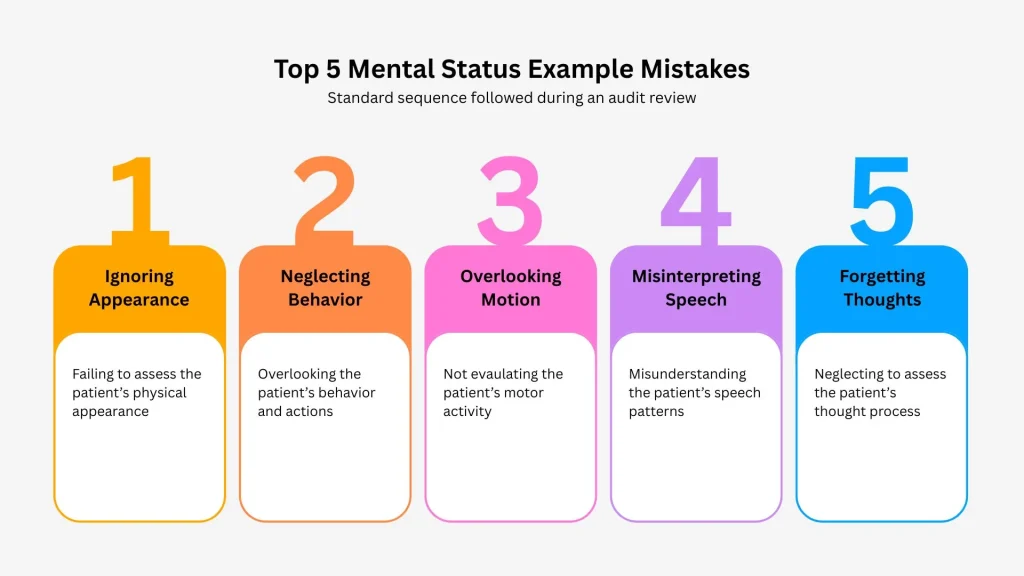
Top 5 MSE Mistakes Infographic
To help clinicians quickly identify and prevent documentation errors, this infographic highlights the top 5 most common mistakes made when using mental status exam templates. It summarizes key pitfalls such as overlooking setting-specific sections, incomplete notes, and poor EMR integration. Reviewing this visual guide regularly can reinforce best practices and enhance accuracy across all clinical environments.
Conclusion
Avoiding common mistakes in MSE template usage improves:
- Accuracy of assessments
- Efficiency of clinical workflow
- Communication among healthcare providers
- Overall patient care quality
Regular updates, staff training, and setting-specific customization are key to maximizing the benefits of mental status exam templates.