Mental Status Paragraph Template Guide

A vague mental status note creates problems fast. It slows handoffs, weakens diagnostic clarity, and leaves too much room for interpretation when another clinician needs to understand what you actually observed. A strong mental status paragraph template solves that by turning scattered findings into a concise, readable narrative that is clinically complete.
For most clinicians, the challenge is not knowing the elements of the mental status exam. The challenge is documenting them under time pressure without leaving gaps or writing a paragraph so generic that it says very little. The best paragraph format gives you enough structure to stay consistent while still leaving room for patient-specific observations.
What a mental status paragraph template should do
A mental status paragraph template is not just a writing shortcut. It is a documentation framework that helps organize core MSE domains into a coherent narrative. In practice, it should support three goals at once: completeness, efficiency, and clinical usefulness.
Completeness matters because omissions change how a note is interpreted. If behavior, speech, mood, affect, thought process, thought content, perception, cognition, insight, or judgment are skipped without explanation, the reader may not know whether the domain was normal, not assessed, or simply forgotten. Efficiency matters because most clinicians are documenting in busy settings where every extra minute counts. Clinical usefulness matters because the note should help with diagnosis, risk assessment, treatment planning, and team communication, not just satisfy a charting requirement.
A usable template also reduces variation between notes. That consistency is especially helpful in emergency departments, inpatient psychiatry, consultation-liaison settings, and training environments where multiple providers may evaluate the same patient over time.
Core elements to include in a mental status paragraph template
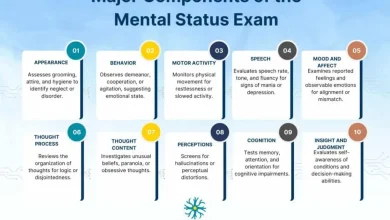
A strong paragraph usually follows the same clinical sequence, even if the exact wording changes. Appearance and behavior often come first because they reflect direct observation from the moment of contact. Speech, mood, and affect typically follow. Thought process and thought content come next, then perception, cognition, insight, and judgment.
That sequence is not mandatory in every setting, but it works because it mirrors how many clinicians assess the patient in real time. It also improves readability. A note becomes easier to scan when each domain appears in a predictable order.
In most cases, the paragraph should account for these domains:
- appearance and grooming
- behavior and psychomotor activity
- speech
- mood and affect
- thought process
- thought content
- perceptual disturbances
- orientation and cognition
- insight and judgment
Some clinicians also include attention, memory, concentration, fund of knowledge, or impulse control, depending on the setting and purpose of the evaluation. The right level of detail depends on the encounter. A brief follow-up note in an outpatient clinic may need less elaboration than an emergency psychiatric assessment or admission evaluation.
How to write the paragraph so it reads like clinical observation
The biggest mistake with MSE paragraphs is reliance on stock phrases that sound complete but contain little information. Terms such as normal, appropriate, or within normal limits are not always wrong, but they are often too broad to be useful on their own.
A better approach is to write in short, specific clinical statements. Instead of saying behavior normal, describe the patient as calm, cooperative, guarded, restless, withdrawn, or agitated. Instead of saying affect appropriate, note whether affect is constricted, blunted, flat, full range, tearful, reactive, or mood-congruent.
Specificity also protects note quality. If the patient has poor eye contact, slowed speech, thought blocking, persecutory delusions, or limited insight, those observations carry more value than broad labels. The template should prompt those details, not replace them.
Clinicians should also separate observed findings from patient report. Mood is generally reported by the patient, while affect is observed by the examiner. Thought content may incorporate both observed and reported material. Keeping that distinction clear strengthens the note and reduces ambiguity.
A practical mental status paragraph template
The most useful paragraph format is one you can adapt quickly. Here is a straightforward model:
The patient appears [well-groomed/disheveled/etc.] and is [calm/cooperative/guarded/agitated/etc.] with [normal/increased/decreased] psychomotor activity. Speech is [normal rate, volume, and prosody / pressured / slowed / sparse]. Mood is described as “[patient’s words],” and affect is [full range/constricted/blunted/flat/labile] and [congruent/incongruent] with stated mood. Thought process is [linear, logical, goal-directed / circumstantial / tangential / disorganized], and thought content is notable for [no delusions, obsessions, or preoccupations / specific findings]. The patient [denies/reports] hallucinations or other perceptual disturbances. The patient is [alert and oriented to person, place, time, and situation], with [intact/impaired] attention, memory, and concentration based on interview. Insight is [good/fair/limited/poor], and judgment is [good/fair/limited/poor].
This template works because it covers the essential domains in a single readable paragraph. It is structured enough to reduce omissions but flexible enough for different patient presentations.
Example of a completed mental status paragraph
The patient appears mildly disheveled but adequately groomed and is cooperative, though intermittently guarded, with mild psychomotor slowing. Speech is soft and slowed but coherent. Mood is described as “down most days,” and affect is constricted and congruent with stated mood. Thought process is linear and goal-directed. Thought content is notable for hopelessness without delusional content; the patient denies suicidal ideation, homicidal ideation, and obsessive thoughts. No auditory or visual hallucinations are reported. The patient is alert and oriented to person, place, time, and situation, with grossly intact memory and attention during interview. Insight is fair, and judgment is fair.
This example is brief, but it communicates enough to support clinical interpretation. It gives direct observations, includes the patient’s own description of mood, and avoids filler language.
When the template needs to change
No single paragraph fits every setting. A mental status paragraph template for outpatient psychotherapy follow-up may emphasize mood, affect, thought process, safety content, and insight. In an emergency department, thought content, perception, orientation, intoxication-related findings, and judgment may need greater detail. On an inpatient unit, psychomotor changes, response to internal stimuli, and behavioral control may be central.
The same applies across patient populations. A note for a patient with mania should capture rate of speech, affective intensity, distractibility, thought acceleration, and judgment. A note for delirium should prioritize attention, orientation, fluctuation, arousal, and perceptual disturbances. A note for dementia assessment may need much more cognitive detail than a routine psychiatric follow-up.
This is where templates help most when they are treated as structured prompts rather than rigid scripts. Standardization improves consistency, but overstandardization can flatten important clinical differences.
Common documentation problems to avoid
One recurring problem is contradiction within the paragraph. If you document thought process as logical and goal-directed but later describe severe disorganization, the note becomes hard to trust unless you explain the variability. Another issue is importing unchanged language from prior notes when the current presentation is clearly different.
There is also risk in overusing undefined psychiatric shorthand. Terms such as poor insight or impaired judgment are common, but they are stronger when supported by context. If judgment is impaired, show how. If insight is limited, indicate whether the patient minimizes symptoms, rejects treatment need, or misattributes the cause of illness.
Finally, avoid documenting domains you did not assess. If cognition was only grossly evaluated through conversation, say that. Precision about the limits of the exam is part of good charting.
How to make your template faster to use
Speed comes from repetition and from reducing decision fatigue. Many clinicians benefit from keeping a standard sentence order and changing only the descriptors. That approach shortens documentation time without sacrificing quality.
It also helps to build setting-specific versions. One paragraph framework for emergency psychiatry, another for outpatient follow-up, and another for inpatient progress notes will usually perform better than one universal block of text. MentalStatusExamTemplate.com focuses on this kind of practical standardization because clinicians need tools that work under real documentation pressure, not idealized examples that only fit textbook cases.
The best test is simple: if another provider can read the paragraph and understand how the patient presented today, the template is doing its job. If the note could apply to almost anyone, it needs more specificity.
A good mental status paragraph should save time, but it should also sharpen your clinical thinking. When the structure is right, the writing becomes quicker, the findings become clearer, and the chart tells the story it needs to tell.